



street demonstration
a visual investigation into a flagship activity of the demonstration society
about the article
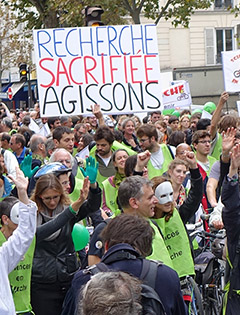
Demonstrations of strength at large street protests, Steve Jobs’s highly publicized presentations of new Apple products, and evidence of the existence of weapons of mass destruction in Iraq presented to the UN: public demonstrations are multifaceted, and their social, economic, and political implications are considerable. Their prevalence means we live in a demonstration society (Rosental 2021), which this essay explores visually, focusing on one of its flagship activities: street demonstrations.
The analysis is based on an ethno-photographic study of the “Sciences en marche” (Scientists on the march) demonstration, which took place in Paris on October 17, 2014, and whose main stated objective was to obtain more funding for public research. This is a common type of demonstration in France: a peaceful gathering, the result of cooperation between organizers and the police, combining a sense of humor, semi-festive activities, and dramatic messages to elicit sympathy and compassion. This type of rally requires significant material and organizational infrastructure, in addition to well-honed expertise (Champagne 1984, Fillieule and Jobard 1998, Traïni 2010).
Journalists generally focus more on the content of the demands and the emotional and impassioned outpourings than on the pragmatic aspects when reporting on street demonstrations. These are the dimensions that this essay seeks to highlight using photographs and the zoom.able format. “Zooming” is used here in a figurative sense. For example, we don’t aim to make the details of the protesters’ clothing visible. Rather, we try to gradually reveal certain practices and features of the material and organizational infrastructure of the demonstration by using three successive layers. The transparency of the photos when zoomed in highlights how the various dimensions overlap.
The first layer shows that the demonstration basically consists of a route (represented in a simplified manner to emphasize its generic nature) and an endeavor to produce witnesses. Indeed, it is important to the organizers that, in the first instance, at least some of the journalists report on the demands in a favorable light and secondarily that passersby and local residents are challenged by the protest actions. The cortege’s onlookers invite us to “zoom in” on what they are observing, and so become immersed as well.
This brings us to the second layer, which specifies what the event allows witnesses to see and hear. Three phenomena are brought to light. First, the demonstration is a media event—the photographs highlight the work of journalists and the information they gather. It also aims to show the representativeness of the people it brings together, by displaying both masses of indistinguishable bodies and a multiplicity of subgroups using various visual devices: costumes (such as white lab coats, academic garb), objects (for example, microscopes), and banners identifying the institutions represented by the protesters. Lastly, various activities are organized for the media (e.g., songs, dances, slogans, speeches, sit-ins) using a variety of visual and audio tools (including megaphones, speakers, whistles, balloons, flags, and signs).
Zooming in more, we arrive at the third layer, which sheds light on another fundamental dimension of the demonstration. It relies on maintaining public order thanks to coordinated actions by the police and security services (e.g., traffic management at intersections, maintaining a traffic lane, actions at the front of the cortege to enable its progression, keeping marchers at a distance from government buildings). These activities and the use of various devices (such as walkie-talkies, vehicles, and armbands) determine the event’s spatial and temporal structure.
credits
text and photographs: Claude Rosental
graphic design: Eugénie Zuccarelli
translation: Monique Gross
copy editing: Bronwyn Mahoney
copyrights and references
copyright and image references
read more read less
photographs © Claude Rosental, 2014, reproduced with permission.
references and bibliography
read more read less
Champagne, Patrick. 1984. “La manifestation. La production de l’événement politique.” Actes de la recherche en sciences sociales 52–53: 19–41.
Fillieule, Olivier, and Fabien Jobard. 1998. “The Policing of Protest in France: Toward a Model of Protest Policing.” In Policing Protest: The Control of Mass Demonstrations in Western Democracies, edited by Donatella della Porta and Herbert Reiter, 70–90. Minneapolis: University of Minnesota Press.
Rosental, Claude. 2021. The Demonstration Society. Translated by Catherine Porter. Cambridge, MA: MIT Press.
Traïni, Christophe. 2010. “Dramaturgie des émotions, traces des sensibilités. Observer et comprendre des manifestations anti-corrida .” ethnographiques.org 21. http://ethnographiques.org/2010/Traini
to cite this article
Rosental, Claude and Eugénie Zuccarelli. 2025. “Street Demonstration: A Visual Investigation Into a Flagship Activity of the Demonstration Society.” .able journal: https://doi.org/10.69564/able.en.25030.manifester
cite this article
MLA
EN
Rosental, Claude and Eugénie Zuccarelli. “Street Demonstration: A Visual Investigation Into a Flagship Activity of the Demonstration Society.” .able journal, 2025. https://doi.org/10.69564/able.en.25030.manifester
ISO 690
EN
ROSENTAL, Claude and ZUCCARELLI, Eugénie. “Street Demonstration: A Visual Investigation Into a Flagship Activity of the Demonstration Society.” .able journal [online]. 2025. Available from: https://doi.org/10.69564/able.en.25030.manifester
APA
EN
Rosental, C., & Zuccarelli, E. (2025). Street Demonstration: A Visual Investigation Into a Flagship Activity of the Demonstration Society. .able journal. https://doi.org/10.69564/able.en.25030.manifester
print this contribution
Use the links below to print this contribution. You have the choice between a high-quality format or an eco-quality format optimized to reduce environmental impact.